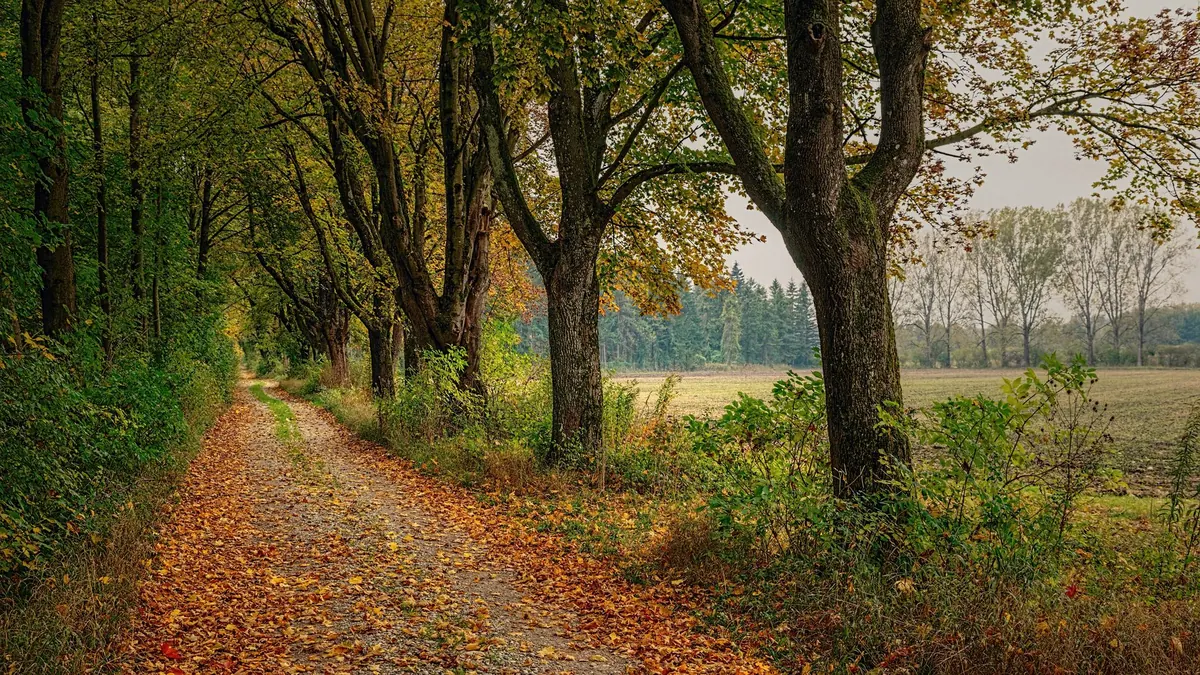
Autumn is the season that rewards a driver willing to stop. Beech turns copper, the light comes in low and sideways, and a journey that feels like a chore in July becomes the whole point of the day. The catch is that the best colour rarely sits next to a motorway junction. It hides up a lane, beyond a car park, at the top of a pass you would otherwise sail straight past. Below are the stops worth building a journey around, and how to fit them in before the light goes.
Plan the day around the light, not the distance
By late October you might have eight or nine usable hours of daylight, and the colour looks its best in the first and last of them. Treat the middle of the day as your walking window and the end as motorway time.
A few habits make autumn driving much easier:
- Check opening times before you leave. Gardens, arboretums and estate car parks often close earlier in autumn than in summer, and some shut at dusk.
- Put the scenic stretch first and the dull A-road last. Driving a woodland lane in the dark wastes a good road.
- Clean the windscreen inside as well as out. Low sun finds every smear.
- Watch for wet leaves and mud, especially in wooded lanes and at junctions where tractors have been out.
- Expect deer at dawn and dusk. The New Forest, the Forest of Dean and Ashdown Forest all have open grazing and long wooded edges.
- Break every couple of hours, and if you feel drowsy, stop somewhere safe and rest properly. Pushing on is not worth it.
Woodland stops with reliable colour
Woodland gives you the most dependable display, because different trees turn at different times. Birch and rowan go early, oak and beech hold on, larch and acers cover the middle weeks. These are all places where a 40-minute stop feels like a proper break:
- Westonbirt, Gloucestershire — the acer glade is the reason people drive from three counties away. Mid to late October is usually the sweet spot.
- Sheffield Park, East Sussex — lakes, mature trees and reflections, with parking and a café at the gate.
- Winkworth Arboretum, Surrey — a hillside site, so the colour comes to you rather than the other way round.
- Bedgebury, Kent — conifers plus broadleaf, which works well on a day when the weather cannot decide.
- Grizedale Forest, Cumbria — oak, larch and sculpture trails, minutes off the A590 if you are heading for the Lakes.
- Padley Gorge, Derbyshire — oak and birch above a brook, an easy leg-stretch on a Sheffield to Manchester run.
- Glen Affric, Highland — native pinewood and birch, and the sort of quiet you remember for years.
Peak week shifts by a fortnight either way depending on wind and frost, so if you can be flexible, wait for a still, bright morning. If you cannot, aim for the middle of the month and accept that some trees will still be green while others are already bare. Mixed woodland usually looks better for it.
Hills and passes where the colour lasts
Higher ground turns earlier and loses its leaves sooner, so hill stops are best in the first half of autumn. The payoff is scale: whole valleys of colour rather than individual trees.
Good options include the viewpoint above Symonds Yat in the Wye Valley, where beech woods drop to the river bend; the Black Mountain road in the Brecon Beacons, which has lay-bys placed for exactly this; and the passes of the Yorkshire Dales and the Lake District, where fell sides turn rust and gold above grey stone walls.
Two cautions. Hill roads are often single-track, so use passing places properly and never stop in one. And cloud can drop without warning: mist on a high road is not the place to admire the view, so keep your lights on, ease off and drop down to a valley stop instead. Quarry car parks and reservoir lay-bys are useful fallbacks when visibility closes in.
Water doubles the display
If you only have time for one stop, choose somewhere with water. A still river or lake gives you the colour twice, and reflections survive a grey afternoon far better than a hilltop view. Early mornings bring mist off the surface, which is often the most photogenic half-hour of the day.
Keswick and Windermere are obvious for a reason, but canals are the underrated option: the Kennet and Avon, the Llangollen and the Macclesfield all have towpath stretches with pubs, benches and easy parking within a short walk. Riverside towns work well too — Bakewell on the Wye, Betws-y-coed on the Conwy, Ross-on-Wye on the river of the same name. Arrive early; small waterside car parks fill quickly on a bright Saturday.
A shape for an autumn day
If you are driving more than three hours in total, this rhythm works well:
- Leave early, while the light is still soft, and drive the motorway first.
- Stop around 10am at a woodland car park for a coffee and a 30-minute loop.
- Eat lunch early, then take the longest walk between 1pm and 3pm, when the light is at its warmest.
- Make one short viewpoint stop on the way out, ideally somewhere you have already seen, so you are not hunting for a space in fading light.
- Finish with the dull roads after dark, and keep the last hour of the journey familiar if you can.
Before you set off
Check for road closures and tree-fall warnings, especially after a windy week. Many minor scenic roads are closed for resurfacing in autumn, and some upland routes shut for the winter altogether.
Pack a torch, a warm layer and something hot in a flask. Download any parking app you might need before you lose signal, and carry a little cash for machines and honesty boxes that still want it. Give the tyres a quick look too — tread depth and pressures matter more on wet, leafy rural roads than on dry motorway miles.
Tell someone roughly where you are going if you plan to walk on remote ground, and assume phone signal will disappear in most of the valleys mentioned above. If a garden or arboretum is the main draw, check its website the day before: last-entry times and ticketed slots can change at short notice.
Do those small things and autumn stops stop feeling like a compromise. They become the best part of the drive.
Photo: Johannes Plenio / Pexels